CausalSentinel
💊 Natalie — Gemini Drug Comparison Agent
Natalie is an AI agent, powered by Google Gemini, that takes two drug names and produces a structured comparison of their molecular properties and safety signals, plus an AI-written summary of the patterns linking the two.
For every comparison the agent autonomously calls two database tools for each drug (2 tools × 2 drugs = 4 tool calls) via Gemini function calling, then assembles the returned data into a side-by-side table.
What it produces
- Side-by-side comparison table of molecular properties (PubChem) and safety signals (openFDA).
- 3–5 sentence AI summary identifying property↔safety patterns.
- A web UI (Streamlit) with a downloadable CSV of the table.
- Documented example runs in
natalie_examples.md.
The two database tools (called autonomously per drug)
| Tool | Source | Returns |
|---|---|---|
natalie_get_molecular_properties(drug) |
PubChem PUG REST | Formula, molecular weight, LogP, H-bond donors/acceptors, TPSA, rotatable bonds |
natalie_get_safety_signals(drug) |
openFDA | Top adverse reactions (with counts), boxed-warning flag, total reports, warnings excerpt |
Both sources are free and require no API key. Only Gemini needs a key.
Screenshots
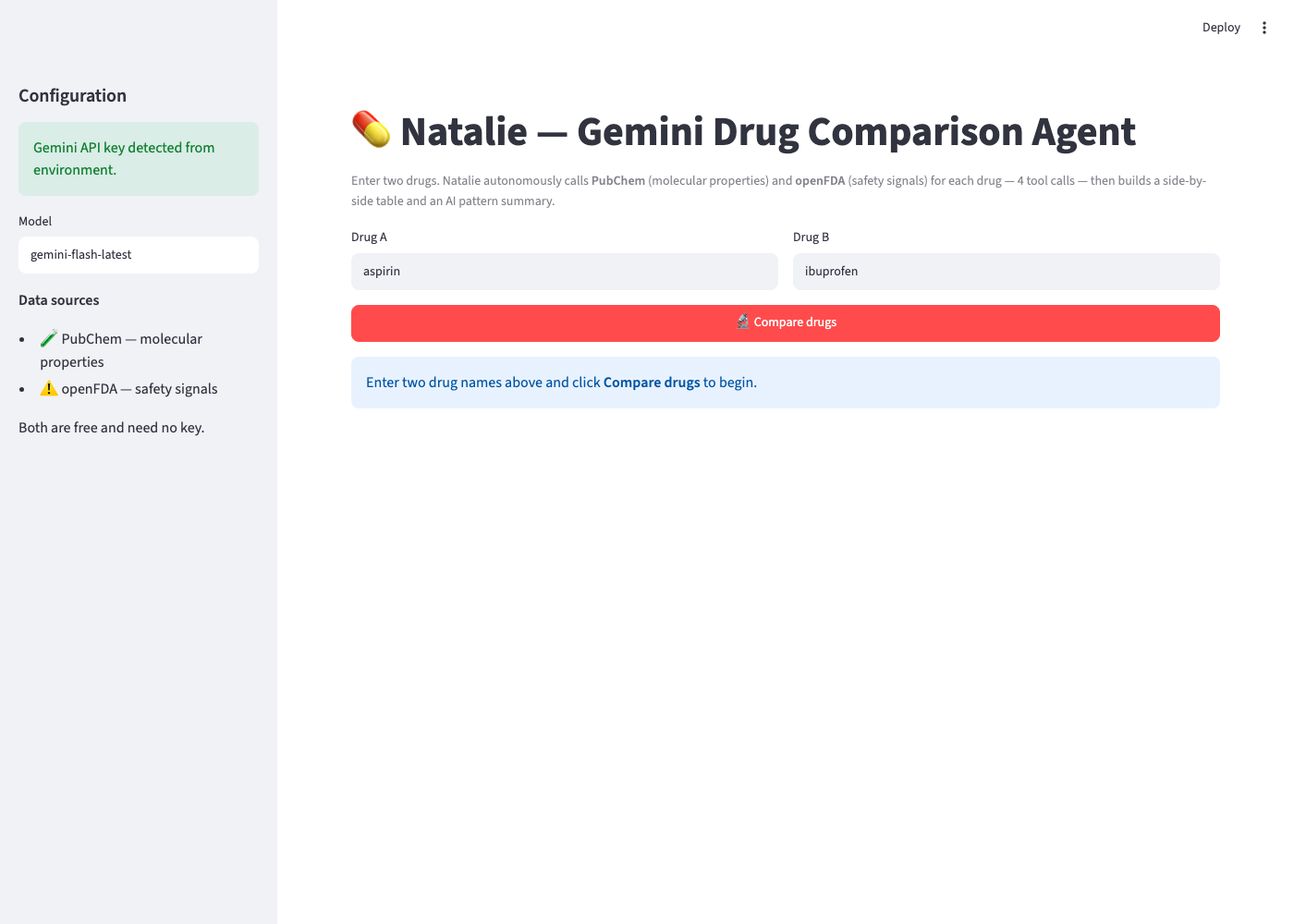
1. Landing page — enter two drugs; the agent’s key/model/data-sources are shown in the sidebar.
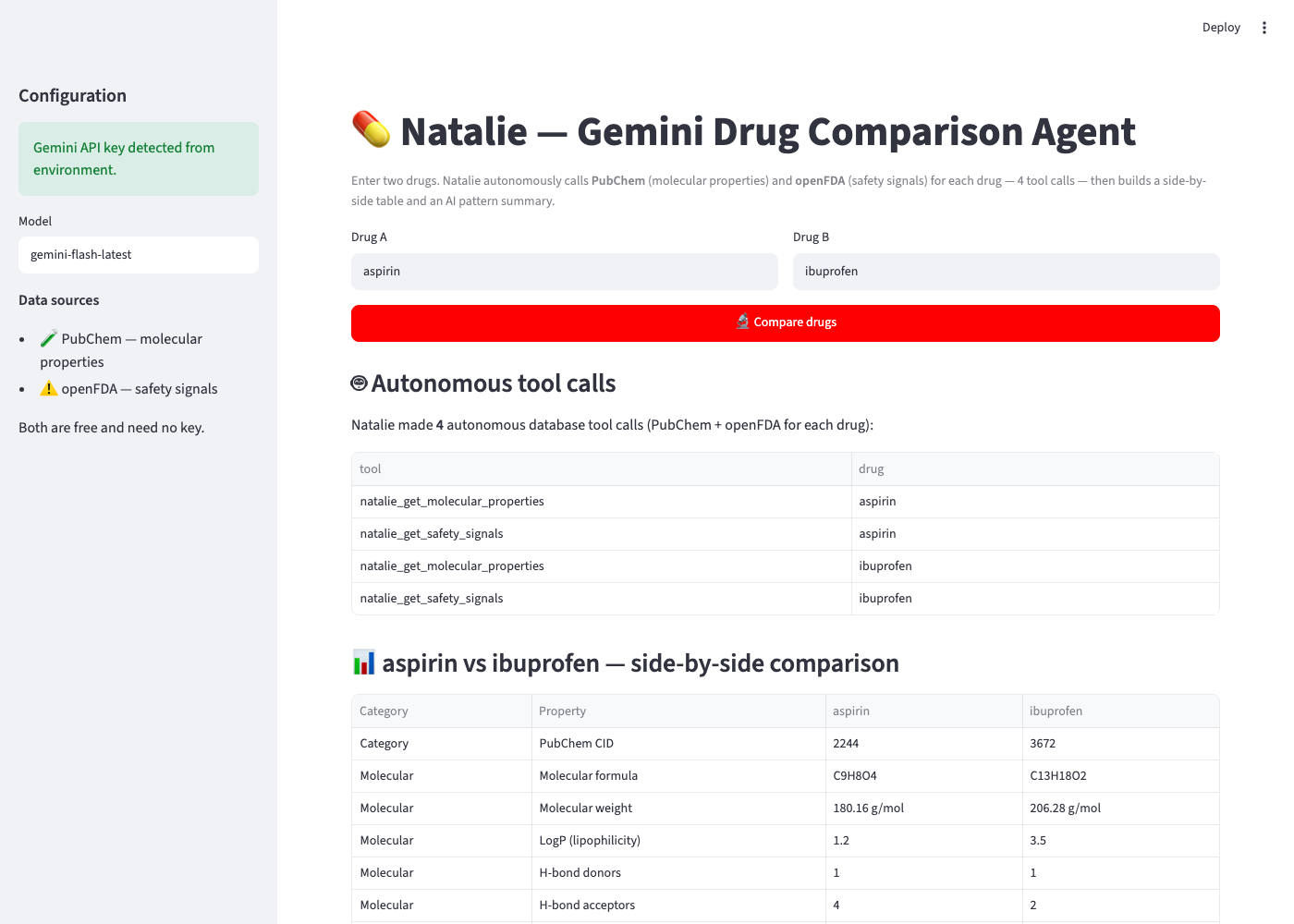
2. Autonomous tool calls + comparison table — Natalie reports the 4 database tool calls it made, then the assembled side-by-side table.
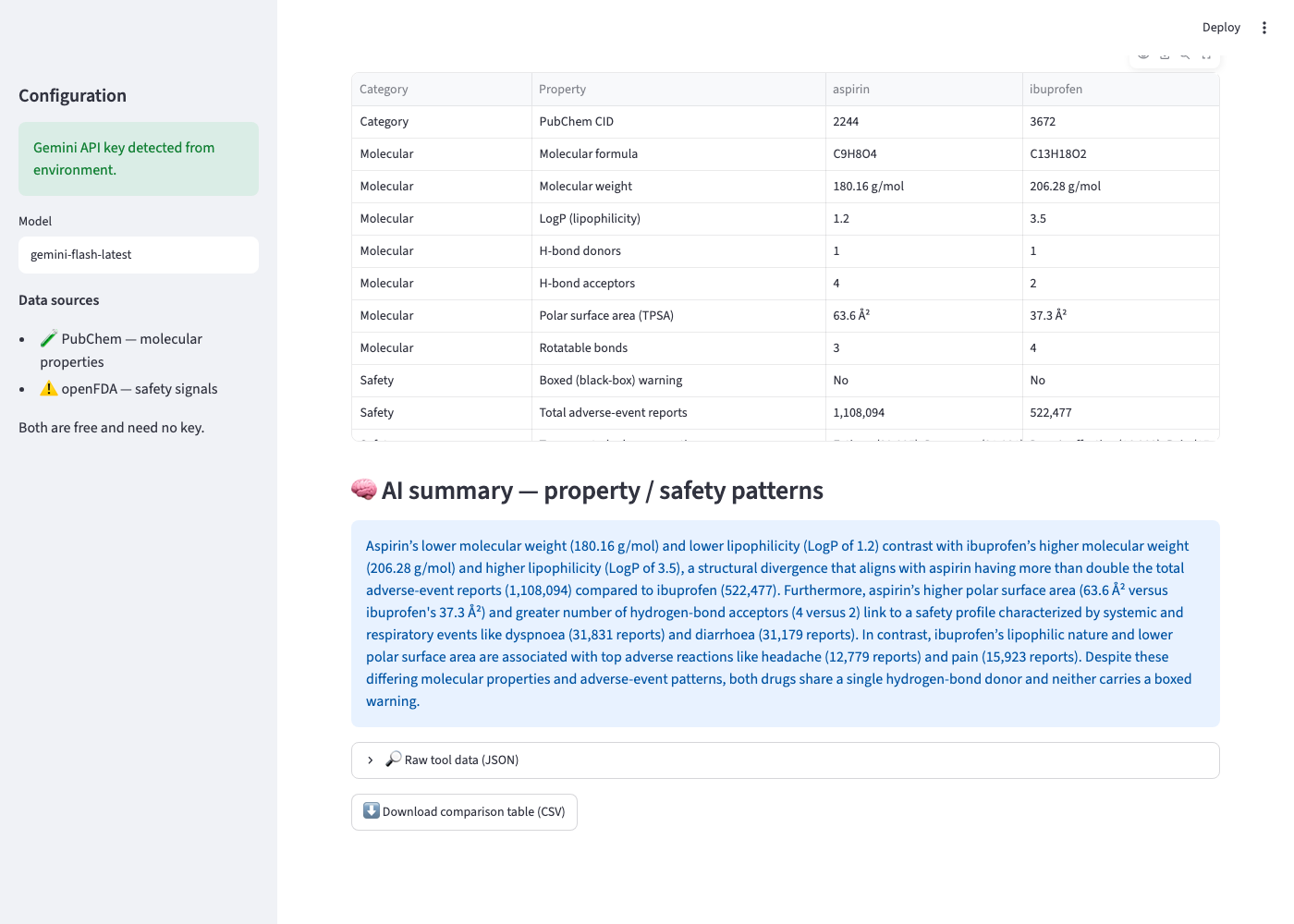
3. AI summary — a 3–5 sentence summary connecting molecular properties to safety signals.
Quick start
1. Add your Gemini API key
Get a free key at https://aistudio.google.com/apikey, then put it in .env:
GEMINI_API_KEY=your_key_here
(A template is in .env.example. The default model is gemini-flash-latest,
a stable alias that always maps to a current Gemini Flash model.)
2. Run everything with one command
./natalie_run.sh
This creates a virtual environment, installs dependencies, runs the two
documented example comparisons (writing natalie_examples.md), and launches the
web app at http://localhost:8501.
Individual commands
./natalie_run.sh setup                       # create venv + install deps only
./natalie_run.sh app                         # launch the Streamlit web app
./natalie_run.sh examples                    # regenerate natalie_examples.md
./natalie_run.sh compare aspirin ibuprofen   # one-off CLI comparison
How it works (architecture)
                 ┌─────────────────────────────────────────────┐
   two drugs ──▶ │  NatalieAgent.compare(drug_a, drug_b)        │
                 │                                              │
                 │  1. Gemini function-calling loop             │
                 │     Gemini autonomously decides to call:     │
                 │       natalie_get_molecular_properties(A)    │──▶ PubChem
                 │       natalie_get_safety_signals(A)          │──▶ openFDA
                 │       natalie_get_molecular_properties(B)    │──▶ PubChem
                 │       natalie_get_safety_signals(B)          │──▶ openFDA
                 │                                              │
                 │  2. Capture the real tool results and build  │
                 │     the structured side-by-side table        │
                 │     (numbers come straight from the tools —  │
                 │      never hallucinated)                     │
                 │                                              │
                 │  3. Gemini writes the 3–5 sentence summary   │
                 │     from the verified table                  │
                 └─────────────────────────────────────────────┘
                                  │
                                  ▼
                   table + summary + tool-call log
Design note: Gemini genuinely performs the tool calls (autonomous function calling), but the table cells are filled from the captured tool outputs, not from model free-text — so every value in the table is real data. Gemini is then asked to summarize only that verified table.
Files
| File | Purpose |
|---|---|
natalie_tools.py |
The two database tools (PubChem + openFDA) |
natalie_agent.py |
The Gemini agent: function-calling loop, table builder, summary |
natalie_app.py |
Streamlit web UI |
natalie_examples.py |
Generates the documented example runs |
natalie_screenshot.py |
Captures the README screenshots (Playwright) |
natalie_run.sh |
One-command runner |
natalie_examples.md |
Output: documented example runs |
.env / .env.example |
Gemini API key configuration |
requirements.txt |
Python dependencies |
Example runs
See natalie_examples.md for full documented runs
(aspirin vs ibuprofen, acetaminophen vs naproxen), each showing the 4 autonomous
tool calls, the comparison table, and the AI summary. Try your own with:
./natalie_run.sh compare warfarin heparin
Disclaimer
Natalie is an educational / research tool. openFDA adverse-event counts reflect reporting volume, not causation or incidence, and are heavily influenced by how widely a drug is used. Nothing here is medical advice.