CausalSentinel






Interns: Shucheng Cao (OpenCausal — causal evidence for drug-target prioritization, also maintained as a standalone repo), Natalie Huang (OpenSentinel — drug-safety comparison) Project Type: Dossier Generator
Overview
Give it a protein and a disease. It decides which public databases to query, queries them, and writes one target evidence card: a short, sourced argument ending in a go / no-go, where every number is traceable to the tool that returned it.
The hard part is not fetching from eight databases. It is making the output something a reviewer can falsify — so the design puts the model where it can do least damage:
| Written by | |
|---|---|
| Evidence table, caveats, sources, provenance | rendered mechanically from tool output — the model never touches them |
| Verdict line + reasoning paragraph | the model — then checked against tool output, and the run fails if a claim has no source |
Try it in ten seconds — no install, no key
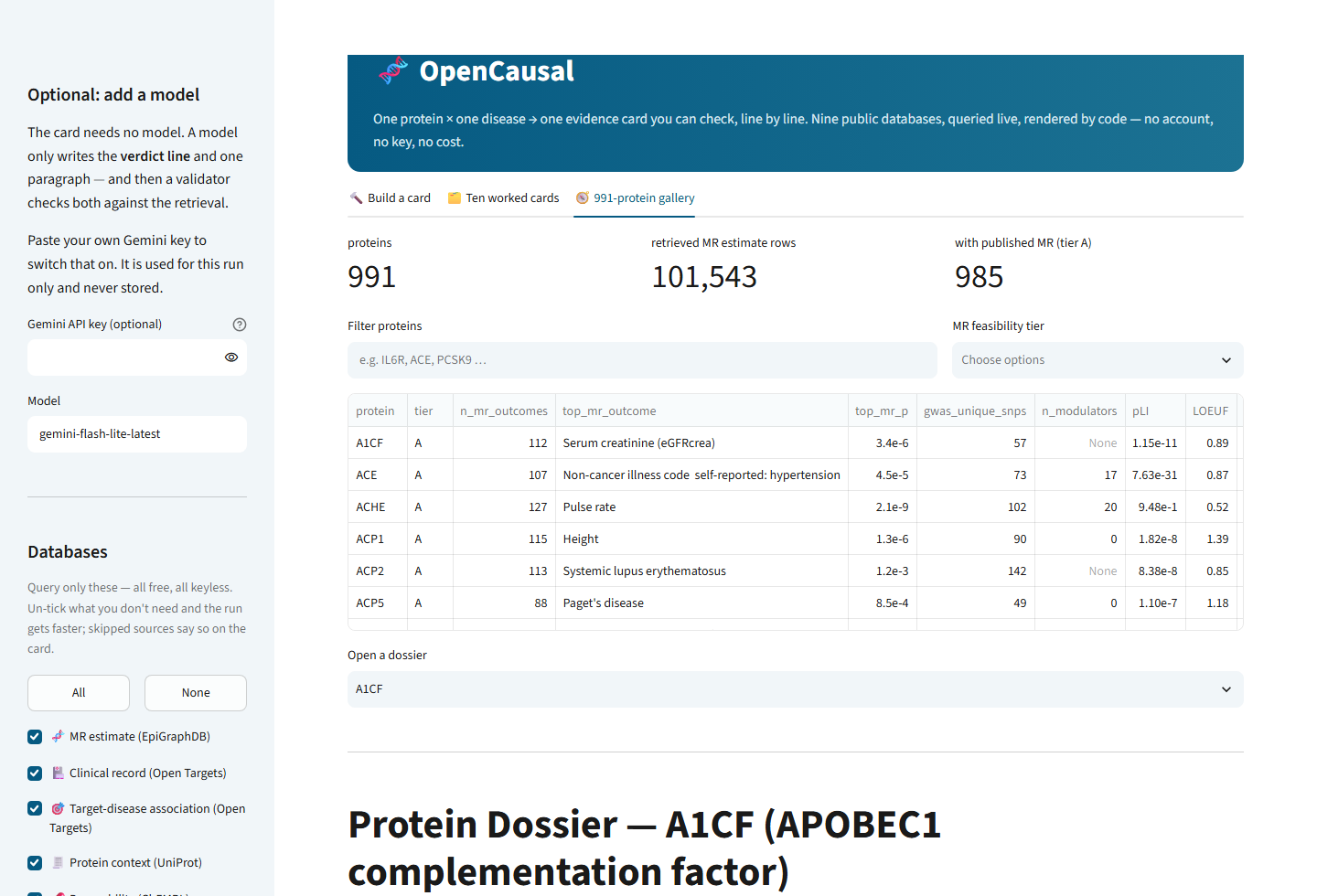
- Browse the 991 pre-generated protein dossiers — one page per protein: its published MR estimates (retrieved, never computed here), pQTL instruments, GWAS signal, and a phenome map. 101,543 protein-outcome estimates indexed in total. Pure static markdown, no language model anywhere in that path (also browsable in-repo).
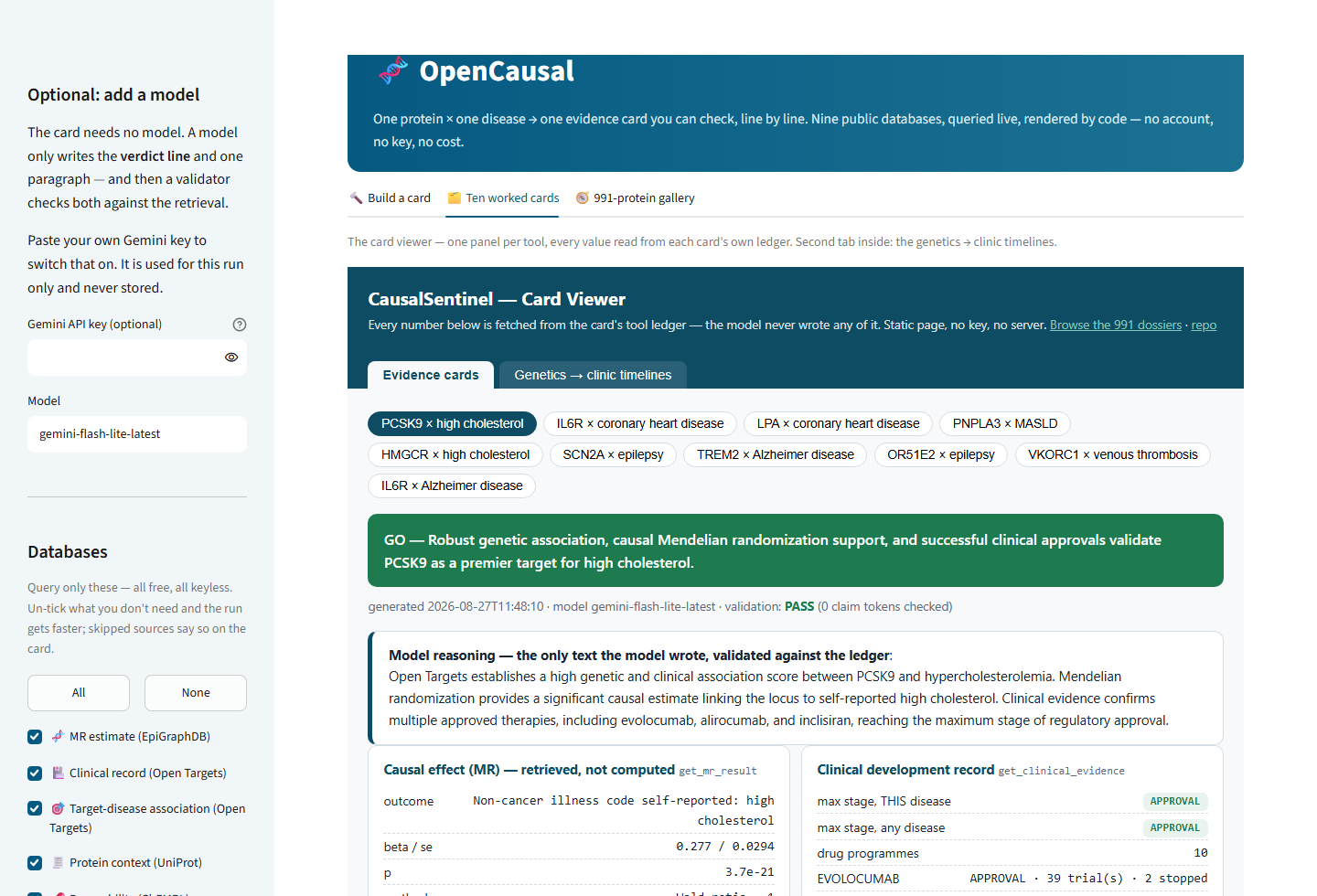
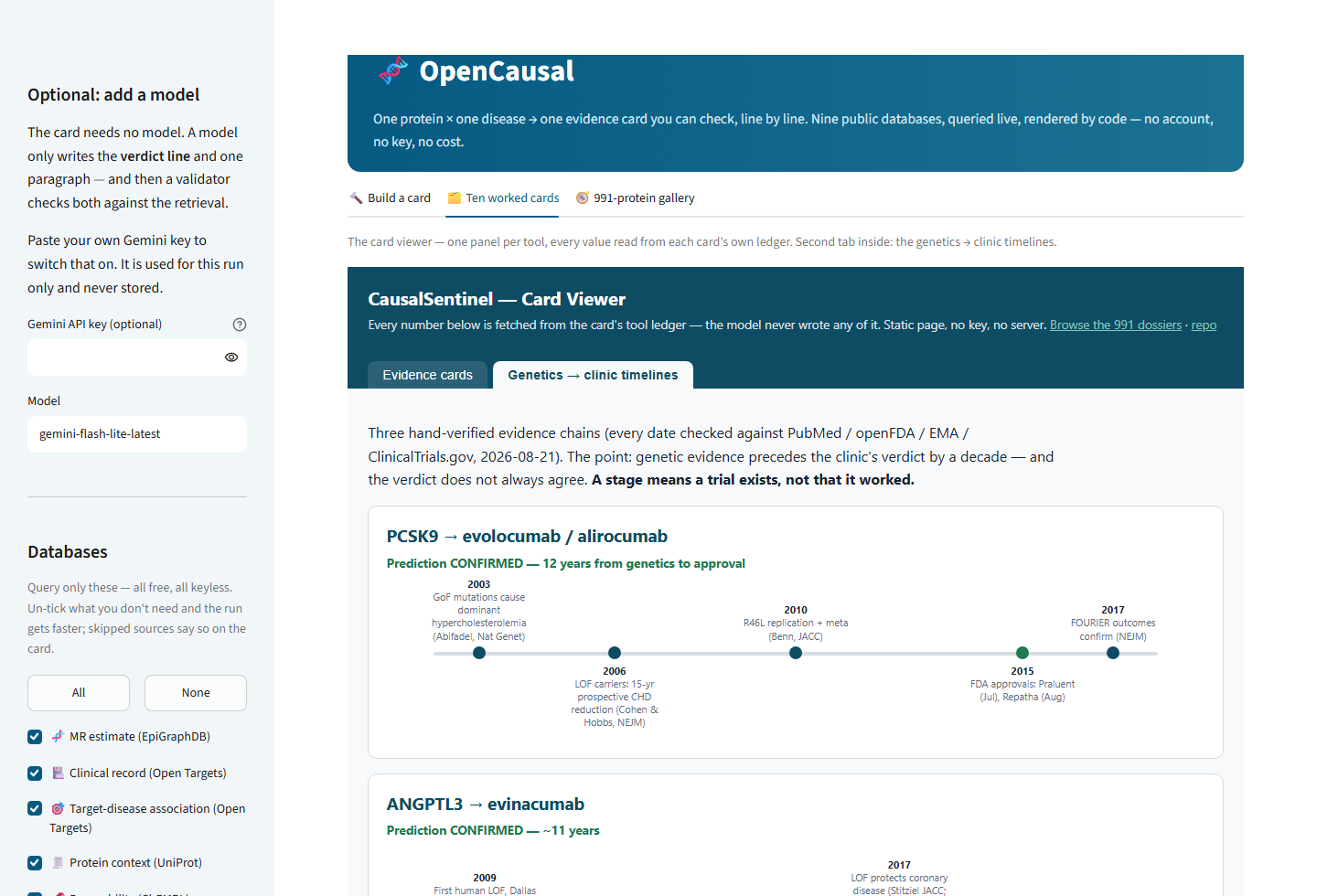
- Open the card viewer — ten worked protein × disease cards, one panel per tool, every value read from each card’s own ledger; second tab shows genetics-to-clinic timelines.
Run the web app — type your own pair (two minutes)
git clone https://github.com/ds4cabs/CausalSentinel.git
cd CausalSentinel
pip install -r requirements.txt
streamlit run app.py
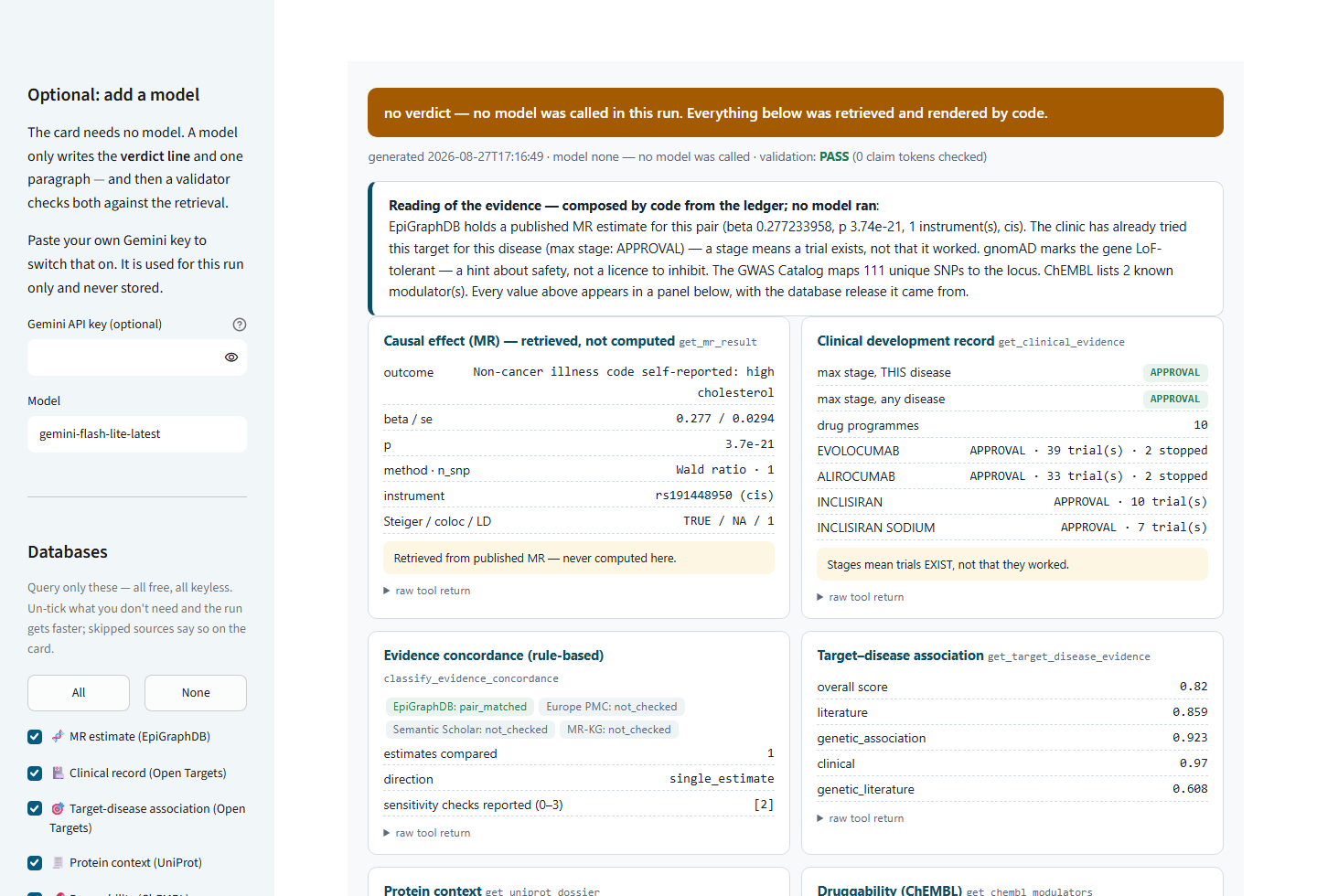
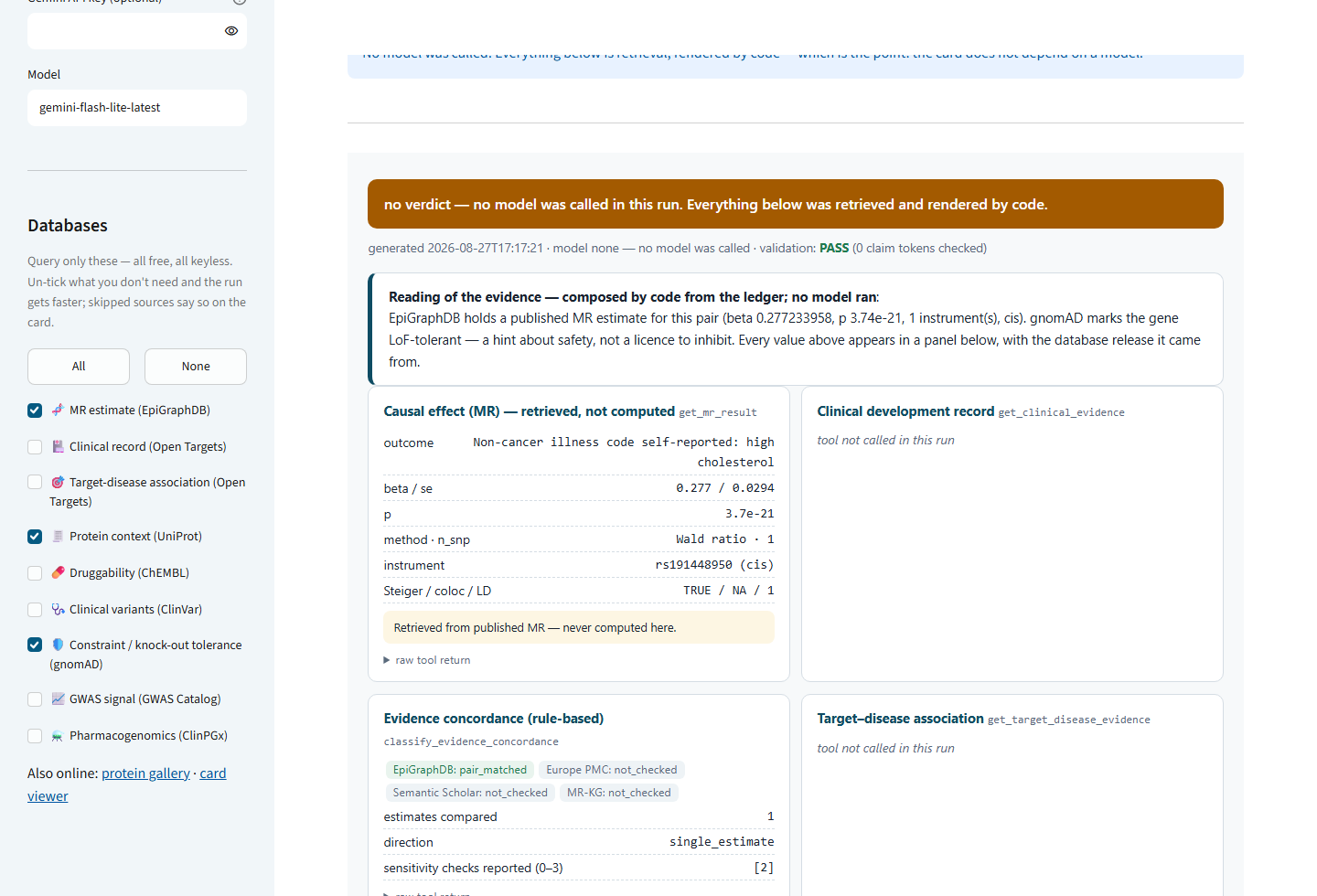
Your browser opens a page: type any protein and disease, press Build the evidence card, and ~20 seconds later the full card is on screen — built from live queries to the nine public databases, all keyless and free. No API key is needed, because the card is rendered by code from tool output; the model only ever writes a one-line verdict and one paragraph. Paste your own free Gemini key in the sidebar (used for that run, never stored) to add those two sentences — and watch the validator check them on the page. A Databases picker in the sidebar lets you query only the sources you need — skipped sources render honestly as “tool not called in this run”.
One app, three tabs — build your own card, browse the ten worked cards, and open any of the 991 protein dossiers:
 |
 |
|---|---|
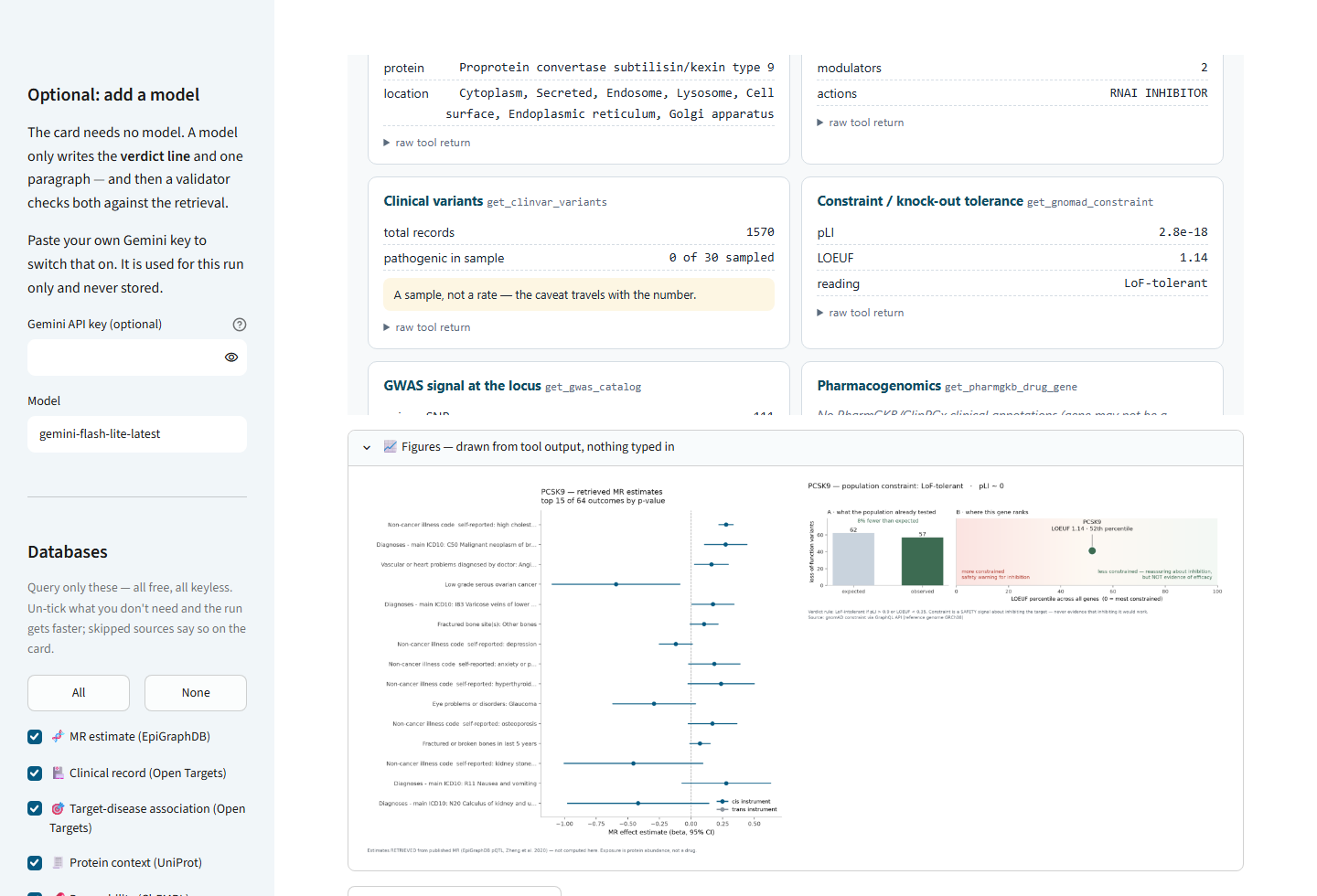
| a freshly built card — verdict, a code-written reading of the evidence, then one panel per tool | under every card: the forest of retrieved MR estimates and the gnomAD constraint figure, drawn live |
 |
 |
|---|---|
| the ten worked cards, same panel-per-tool engine | hand-verified genetics → clinic timelines — genetic evidence precedes the clinic’s verdict by a decade |
 |
 |
|---|---|
| the 991-protein gallery: filterable index, dossiers rendered in-app | pick your databases — query only what you need; skipped sources say so instead of pretending |
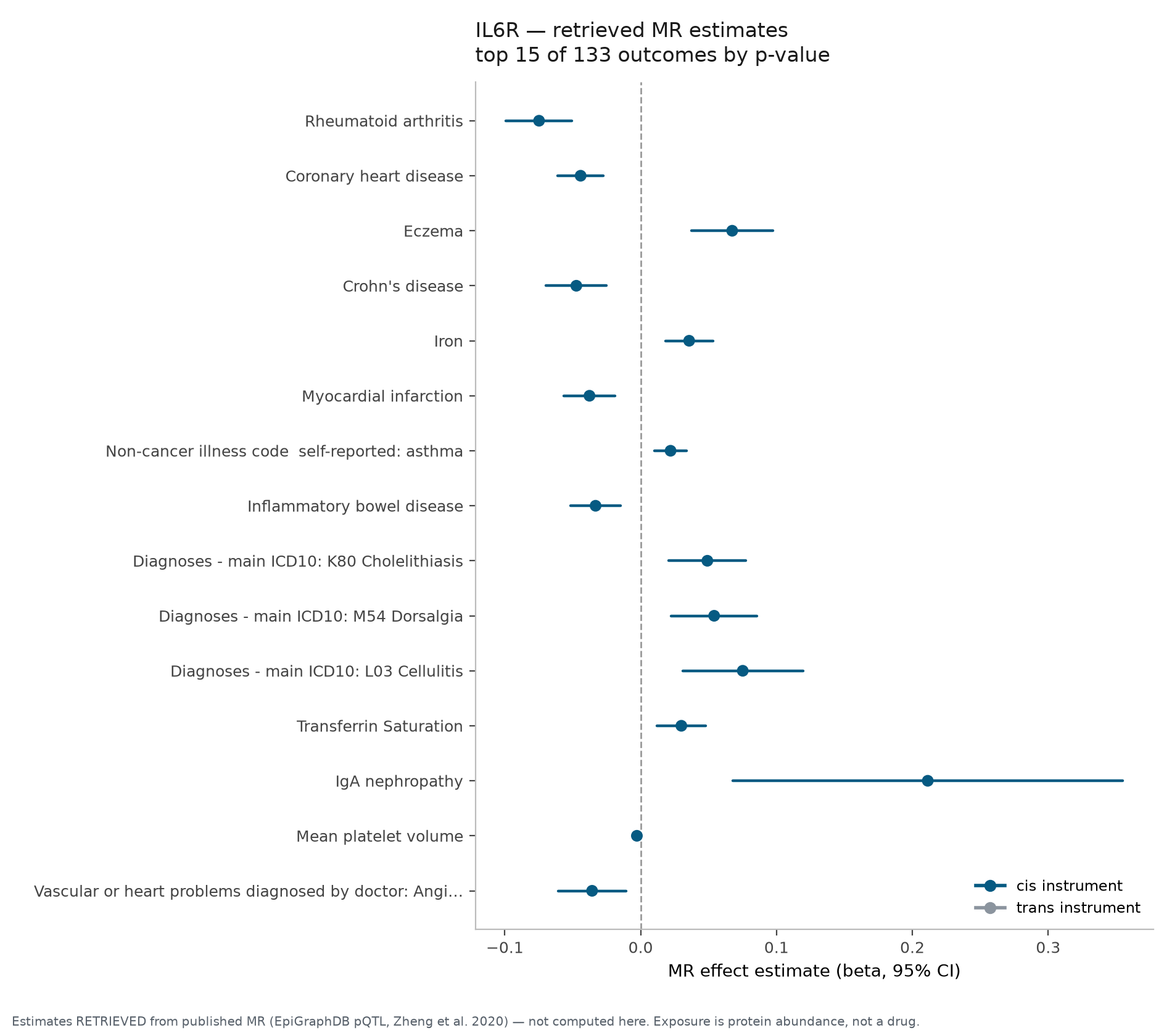
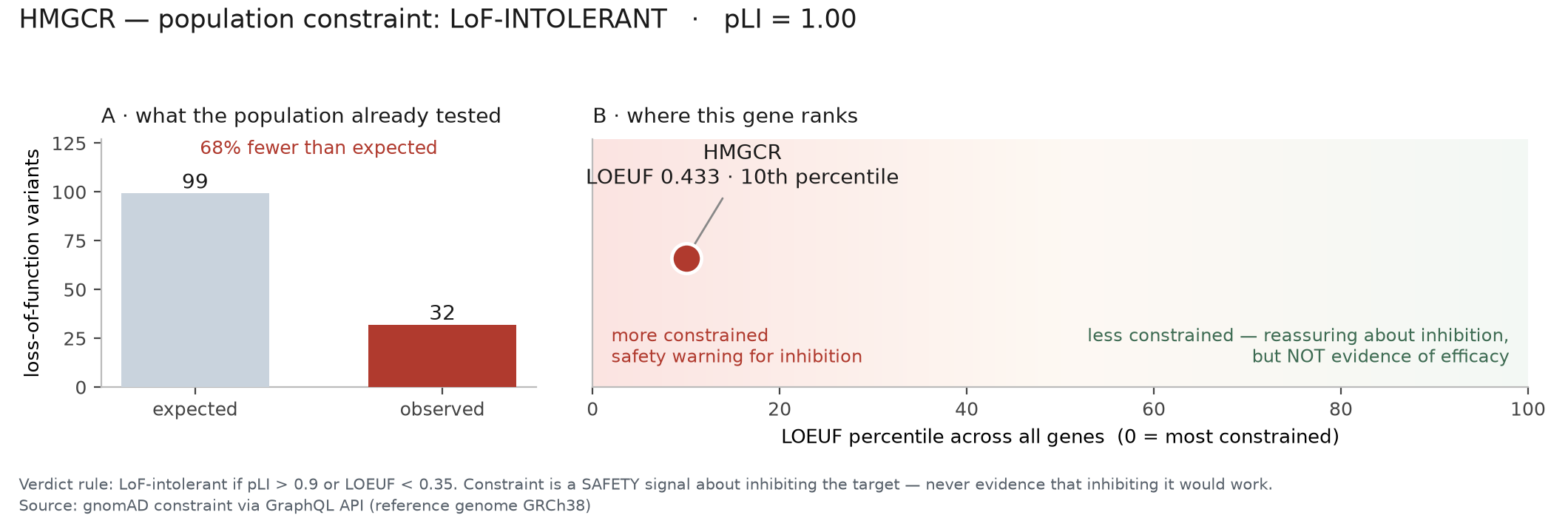
The figures are drawn from tool output too — nothing on these axes is typed in by hand:
 |
 |
|---|---|
| retrieved MR estimates for IL6R — top 15 of 133 outcomes; the truncation is printed on the figure | where HMGCR sits on the knock-out-tolerance scale; the verdict comes from the tool, not the figure |
What it does and does not do
- It retrieves published Mendelian randomization estimates (EpiGraphDB pQTL resource, Zheng et al. Nat Genet 2020) — beta, se, p, method, cis/trans instrument, Steiger direction, colocalization probability where available.
- It does not compute MR or colocalization. No instrument selection, no harmonisation.
Every estimate is labelled
computed_here: false. - Coverage is partial and the card says so. Proteins with no plasma pQTL instrument return “not available” — which means no estimate, not no effect.
- Where no GWAS was ever run, no agent can help. That data still has to be generated by a human. This is the line between a tool and the science.
Core tools (9, all live)
| Tool | Source | Answers |
|---|---|---|
get_mr_result |
EpiGraphDB pQTL MR | is there a published causal estimate for this protein → disease? |
get_clinical_evidence |
Open Targets (ChEMBL + trial registries) | has the clinic already tried this target — which drugs, what stage, why did trials stop? |
get_target_disease_evidence |
Open Targets | how strongly is this target associated with this disease? |
get_uniprot_dossier |
UniProt | what is this protein and where does it act? |
get_chembl_modulators |
ChEMBL | is it already druggable, and by what? |
get_clinvar_variants |
ClinVar (NCBI) | are there clinically classified variants? |
get_gnomad_constraint |
gnomAD | is it LoF-intolerant — i.e. a safety warning? |
get_gwas_catalog |
GWAS Catalog | how much genetic signal maps to the locus? |
get_pharmgkb_drug_gene |
PharmGKB / ClinPGx | any pharmacogenomic relationships? |
Each tool reports its source_release (UniProt release, ClinVar build, ChEMBL version,
Open Targets data release, EpiGraphDB build), so a card is reproducible rather than merely
timestamped.
What a card actually looks like
Not a description of one — the real thing, cards/PNPLA3_MASLD_evidence_card.md, trimmed:
**Verdict:** GO — Strong genetic and literature association with MASLD supports its pursuit.

> **You asked about "MASLD". This card scored MONDO_0013209 — metabolic dysfunction-
> associated steatotic liver disease.** If those are not the same thing, every number
> below answers a different question.

| Evidence | Tool | Result |
|---|---|---|
| Causal effect (MR) — retrieved, not computed | `get_mr_result` | **not available** — no pQTL MR
  estimate for this protein in the resource (absence of an estimate is not evidence of no effect) |
| Clinical variants | `get_clinvar_variants` | 216 ClinVar records; 0 pathogenic in a sample of 30 |
| Population constraint / LoF tolerance | `get_gnomad_constraint` | pLI=1.6e-14, LOEUF=1.26 → LoF-tolerant |
| Extra genetic evidence | `get_gwas_catalog` | 114 unique SNPs from 256/256 association rows |
| Pharmacogenomics | `get_pharmgkb_drug_gene` | 2 clinical annotation(s) over 6 drug(s):
  asparaginase, cyclophosphamide, daunorubicin, ethanol +2 more — ClinPGx evidence level 3
  (scale 1A strongest to 4 weakest) — e.g. rs738409 (PNPLA3); ethanol; Alcoholism (level 3 Toxicity) |

## Caveats declared by the tools
- **`get_clinvar_variants`** — Pathogenic count is over the 30 record(s) retrieved, NOT over
  all 216 ClinVar records for this gene; it is a sample, not a rate.
Four things to notice, because they are the design:
- The substitution is shown on both sides. You typed “MASLD”; the card says what it actually scored. You cannot audit a resolution you cannot see.
- “not available” is never “no effect.” An absent estimate is an absent estimate.
- Denominators travel with counts.
0 pathogenic in a sample of 30out of 216, and the caveat block says outright that this is a sample and not a rate. - Every row names the tool that produced it. The
.jsonbeside the card carries the full ledger — every call, its arguments, its verbatim return — so any card can be re-derived and diffed.
Older versions of this same card are frozen in cards/archive/, one folder
per version, each with a README saying what that version got wrong and where it was fixed.
Tech Stack
Python, google-genai (Gemini SDK; the older google-generativeai is deprecated),
requests, python-dotenv.
Getting Started — full CLI
Prerequisites: Python 3.10+. A free Gemini API key is needed only for agent.py
(the model’s two sentences); put it in ../.env as GEMINI_API_KEY (see
.env.example — the .env file lives one level up and is never committed). The
individual tools, the validator tests and the web app’s no-key mode need no key at all.
# 1) create and activate an isolated environment
python -m venv .venv
.venv\Scripts\activate            # Windows  (macOS/Linux: source .venv/bin/activate)

# 2) install dependencies
pip install -r requirements.txt

# 3) test a single tool on its own (no Gemini key needed)
python tools\uniprot.py
python tools\mr.py                 # PCSK9, IL6R, PNPLA3 — including an honest "no estimate"

# 4) run the agent on one pair -> writes a card to cards/
python agent.py --protein PCSK9 --disease "high cholesterol"

# 5) or run the benchmark set (10 pairs chosen to exercise different branches)
python agent.py --batch pairs_benchmark.txt

# 6) validator regression tests (60 cases, no network, no key)
python test_validator.py
Output: cards/PCSK9_high-cholesterol_evidence_card.md (+ .json). The .json carries
the full tool ledger — every call, its arguments and its verbatim return — so any card
can be re-derived and diffed. The JSON is the record; the markdown is the readable view.
Architecture
agent.py          orchestrates: wrap tools -> model calls them -> render -> validate
  ledger.py       captures every tool call's arguments and verbatim return value
  render.py       builds table + caveats + sources + provenance FROM the ledger
  validate_card.py  fails the run if the model's prose outruns the ledger
  tools/*.py      one database wrapper each; one public function returning a dict
  system_prompt.md  the agent's rules
Gemini’s automatic function calling normally executes tools inside the SDK, so the caller
never sees what came back and the card is whatever the model remembers. ledger.py wraps
each tool so the return values survive — which is what makes deterministic rendering and
validation possible at all.
Proteome sweep — the whole searchable universe, no LLM, no key
proteome_sweep.py turns the same tool layer into a lookup resource: one MR-feasibility
dossier per protein, generated mechanically (no language model anywhere in this path).
python proteome_sweep.py --pilot        # 8 proteins covering all three tiers
python proteome_sweep.py --all         # all 991 proteins (985 Tier A)
The output ships in this repo: browse the dossier index.
Each dossier answers, in order: (1) which published MR estimates exist (retrieved);
(2) whether pQTL instruments exist even where no MR was run — Tier B: the un-run
analyses; (3) the actual GWAS Catalog results at the locus (trait, best p, lead SNP,
study); (4) a phenome map of genetically-associated diseases, each overlaid with its
MR status — rows with genetic signal and no MR estimate are labelled candidate analysis,
which is the research-opportunity / comorbidity-hypothesis space; (5) druggability and
safety annotation. dossiers/master_index.csv is the cross-check table over all proteins.
| Tier | Meaning |
|---|---|
| A | published pQTL-MR estimates exist (Zheng et al. 2020, via EpiGraphDB) — shown |
| B | a pQTL GWAS exists but no MR estimate here — instruments derivable, analysis un-run |
| C | no plasma pQTL found — gene-level genetic evidence only, as an honest preview |
What the validator catches
Fabricated numbers (compared numerically, tolerant of honest rounding and of “over N” / “nearly N” bounds), fabricated rsIDs and accessions, unsupported qualitative claims (“FDA-approved”, “monoclonal antibody”, “small-molecule”), causal language when the MR tool returned no estimate, and any claim that this agent performed MR itself.
On the 10-pair benchmark it currently rejects 2 cards — each for a real defect, not a false
alarm. Run test_validator.py after any change to it.
OpenSentinel — the drug-safety side (Natalie Huang)
The repo’s companion sub-project, shipped in nathdrug/natalie-drug-agent/:
a drug-comparison agent. Give it two drug names, and it autonomously calls
PubChem (molecular properties) and openFDA (FAERS safety signals) for each —
four tool calls — then builds a side-by-side comparison table, an AI pattern summary,
and a CSV export, all in a Streamlit UI. Both databases are free and keyless; only the
summary uses a Gemini key.
Run it (two minutes, same pattern as the app above):
cd nathdrug/natalie-drug-agent
pip install -r requirements.txt
streamlit run natalie_app.py
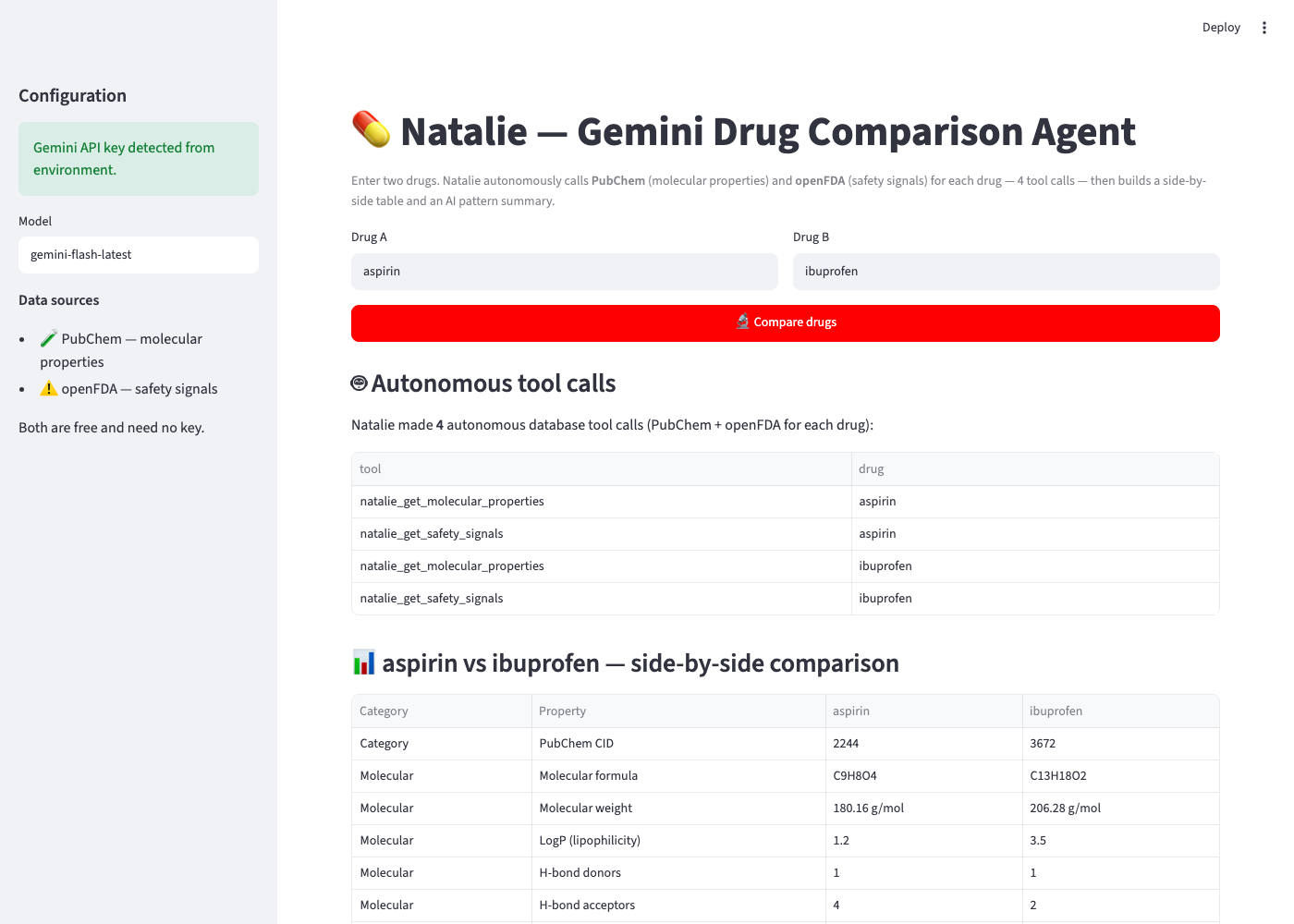
Details, examples and screenshots: her README.
Original scope: MVP_Natalie.md · merged in
#20.
Together the two halves cover the target-selection question from both directions: OpenCausal asks “is this protein worth pursuing?” from the genetics up, and OpenSentinel asks “how do the candidate drugs actually differ?” from the pharmacy down.
Notes
This project is the cohort’s causal evidence reference implementation with strong variant-level rigor. Built in rounds (each ships); Round 1 = a 3-tool card end to end.
License: MIT — Copyright (c) 2026 Chinese American Biopharmaceutical Society (CABS) / ds4cabs.
Found a problem?
That is exactly the feedback this project wants — a card that reads wrong, a dossier number that does not match its source, anything hard to use. Open an issue — a one-line complaint is enough.